MizuMakes may earn a commission from links in this post.
The short version: the Flashforge Creator 5 Pro is a reasonable deal at its current price, but only if you want four dedicated tools and a heated chamber in one box. If you mostly print single-material functional parts, the Bambu P2S Combo is $200 cheaper and probably the better buy. Prices below are US prices as of November 1, 2026. Sales are moving daily, so check the cart before you commit.
Current US prices and price history
Flashforge’s US store lists the Creator 5 Pro at $849, down $100 from its $949 regular price. On top of that, the store’s Black Friday “Surprise Sale” applies an automatic discount at checkout, advertised as up to $200 off 3D printers. Flashforge doesn’t say how much of that applies to this model, so add it to your cart to see the real number. Makers101 logged it at $799 on October 26, which suggests a checkout price around there is realistic. The sale started October 20 and runs to November 30. A $30 stacking code expired October 31.
The history matters here. In September the Pro listed at $949 with an automatic $100 cart discount, so the effective price was $849. Launch deposit pricing was $799 for the Pro. So $799 is a return to the launch floor, not a new low. One tracker says it undercuts the lowest price it has recorded since May. That is a fair price, not a steal.
The real low is on a marketplace. Flashforge’s official AliExpress store listed it at $769.56, and a promo code took it to $639.56. A separate tracker showed $649.66 on November 1. I can’t verify warranty handling, returns, or tariff treatment on those listings. Weigh that against roughly $150 saved.
The competition, for context:
- Bambu P2S Combo: $649 against a typical $749. That is below the $749 it held every day from October 4 to 26.
- Bambu H2D Combo: $1,599, $400 under last year’s Black Friday price of $1,999. One tracker’s log runs $2,699 in May 2025, $2,299 in October 2025, $1,999 in June 2026 and $1,699 in July 2026. So $1,599 is a record low.
- Snapmaker U1: $749 against a $999 list price on Snapmaker’s US store, although the page showed it as unavailable when indexed. It hit $721.65 for Prime members during Prime Day.
- Prusa CORE One+ INDX: Prusa’s Black Friday gifts do not apply to printers with INDX or to conversion kits. Prusa’s INDX page lists $1,999 assembled with 4 tools and a $1,699 4-tool kit. The 8-tool versions are $2,249 assembled and $1,949 as a kit.
Comparison table
| Creator 5 Pro | Bambu P2S Combo | Bambu H2D Combo | Prusa CORE One+ INDX (4-tool kit) | Snapmaker U1 | |
|---|---|---|---|---|---|
| Price now | $849 ($799 seen) | $649 | $1,599 | $1,699 | $749 |
| Multi-material | 4 tools | AMS 2 Pro, 4 slots | Dual nozzle + AMS 2 Pro | 4 tools, up to 8 | 4 tools |
| Build volume (mm) | 256×256×256 | 256×256×256 | 350×320×325 | 248×205×270 | 270×270×270 |
| Chamber | Active, up to 65 °C | Enclosed | Active, 65 °C | Enclosed, 55 °C | Open top; cover optional |
| Max nozzle | 320 °C | 300 °C | 350 °C | 300 °C | 300 °C |
Spec sources: Flashforge lists 256 mm cube, 320 °C and 65 °C chamber. The P2S is 256 mm cube with a 300 °C max nozzle. The H2D is 350×320×325 mm with a 350 °C nozzle and 65 °C active chamber. The INDX build volume is 248×205×270 mm, with a 55 °C chamber. Prusa’s own page lists 300 °C max nozzle. The U1 is 300 °C. It has a 270 mm cube.
Toolheads vs purge waste
The four-tool machines all avoid pushing every color through one nozzle. How well they do that differs.
Prusa claims about 12 seconds and about 0.013 g of waste per color change on INDX. That is a vendor figure. The Creator 5 Pro is more complicated. How-To Geek reports swaps typically around 7 seconds and about 0.5 g purged per color. But Notebookcheck measured 36 g of waste on a 16 g four-color Benchy at factory settings. It also notes the machine purges straight into the build chamber, and that there is no nozzle cleaning and no official dryer. So ‘zero purge waste’ is marketing. Expect to tune the profile.
The U1 swaps in about five seconds, with Snapmaker claiming usage at 20% of normal. The P2S and H2D work differently. They use AMS filament changing, so waste scales with color changes. I didn’t find a sourced waste figure for them, so check profile numbers yourself.
For functional parts, this matters less than for multicolor prints. The practical benefit of a toolchanger is dedicated nozzles. You can keep one nozzle on an abrasive filament and another on a soft one, with no cross-contamination. A common case is PETG-CF or PA-CF structure with a different support material. The Creator 5 Pro ships hardened-steel nozzles and all four tools reach the full bed. The U1’s stock nozzles are stainless steel, so abrasive filaments become a wear item there.
Enclosure and engineering filaments
This is where the field splits. ABS, ASA, nylon, and PC shrink as they cool, and the warp comes from the part cooling unevenly. A warm chamber reduces that. Printed parts also come in below datasheet strength across layers, so a warm chamber that helps layer fusion matters.
The Creator 5 Pro and H2D have active chamber heating up to 65 °C. Notebookcheck’s table lists the Creator’s chamber at 60 °C, so expect slightly under the headline figure. The CORE One+ INDX tops out at 55 °C, still enough for ABS and ASA. The P2S is enclosed, and Bambu markets ABS and ASA printing door-closed with Active Airflow.
The U1 is the weak point. Tom’s Hardware notes it is not officially rated for high-temperature filaments without the optional top cover. Even with the cover, it only traps bed heat, up to about 50 °C. It suits PLA, PETG, and TPU. For nylon or CF-filled materials, look elsewhere. The 300 °C nozzle limit also rules out the hottest materials.
For material choices, our PETG brand comparison and outdoor filament guide cover the numbers. I did not pull filament datasheets for this post.
Who should buy which
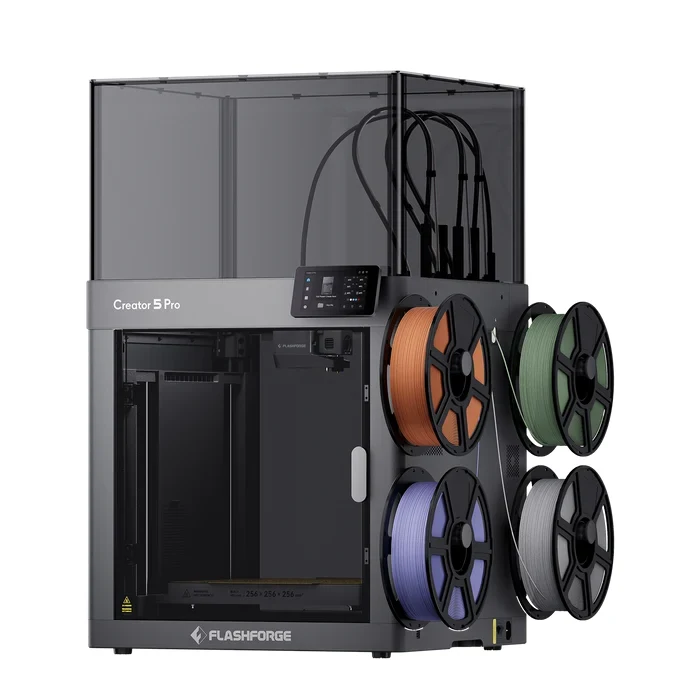
Creator 5 Pro at $799–$849 (or about $640 via marketplace): the cheapest enclosed four-tool machine with a real chamber heater and 320 °C hotends. It fits someone running PETG-CF, ABS, or ASA with a second tool for supports, or small batches of multicolor parts. Accept the weaker ecosystem and manual spool handling. Nylon needs an external dryer, since the spools sit outside any drying system. See Flashforge Creator 5 Pro.
P2S Combo at $649: the default for most people. It is cheaper than all the toolchangers here, and the AMS 2 Pro dries filament. Choose it if parts are mostly single-material and you can live with purge waste. Our P1S vs P2S comparison covers the tradeoff. See Bambu Lab P2S Combo.
H2D Combo at $1,599: buy it for size and temperature headroom: 350×320×325 mm, 350 °C, and a 65 °C chamber. It is the only one here that handles large functional parts and high-temp materials together. It is overkill for small brackets. Our Bambu lineup post explains where it sits against the H2S and X2D. See Bambu Lab H2D.
Prusa CORE One+ INDX: the lowest-waste option and the best-documented ecosystem, but it is the most expensive and the build volume shrinks. Prusa’s page also showed new orders estimated to ship after December 21, 2026. That page shows converted prices, so confirm the date at checkout. I covered the system in why the 8-tool INDX might be my next printer. See Prusa CORE One+.
Snapmaker U1 at $749: the cheapest toolchanger and a good fit for PLA, PETG, and TPU multicolor work. Skip it for engineering filaments unless you add an enclosure. See Snapmaker U1.
The verdict on the deal
At $799–$849 the Creator 5 Pro is a fair price but not a bargain against the $649 P2S Combo. It makes sense if you want dedicated tools and a chamber heater and are willing to tune purge settings. If you can accept marketplace buying risk, the roughly $640 AliExpress price is the one to watch. For a single-material workflow, spend the $150–$200 elsewhere.