MizuMakes may earn a commission from links in this post.
My Bambu P1S has been the workhorse of this shop for well over 1,000 hours, and it isn’t going anywhere. But the kind of parts I print has been drifting. Less PLA, more ASA and carbon-fiber nylon, and more prints where I want two materials in the same part. That’s where the P1S and its AMS start to fight me, so I went shopping for a second printer.
It came down to the Bambu H2D and the Flashforge Creator 5 Pro. I picked the Creator 5 Pro. Here’s why.
Four toolheads instead of one nozzle and a purge tower
The AMS is a filament switcher. Every color or material change pulls one filament out of a single hot nozzle, loads the next, and purges the old one into a pile of poop. For multicolor decor that’s an annoyance. For functional parts it’s a real cost, because the waste scales with the number of swaps, and a part with a soluble or breakaway support interface can swap on nearly every layer.
The Creator 5 Pro takes the other approach: four independent toolheads that park and get picked up as needed. Each tool already has its own filament loaded and hot, so a material change is a tool change, not a full unload and reload. Flashforge markets it as “zero purge waste.” That’s optimistic. Notebookcheck measured 36 g of waste on a 16 g four-color Benchy at factory settings, partly because the stock profile still primes each tool. So I’m treating “low waste once tuned” as the realistic target, and tuning that profile is one of the first things I’ll be testing.
The H2D splits the difference with two nozzles plus an AMS. That’s better than one nozzle, but beyond two materials you’re back to swapping and purging.
A nozzle for every material
This is the reason that matters most for how I print, and it’s the one people talk about least.
Abrasive filaments like PA6-CF chew through brass. The usual answer is a hardened steel nozzle, but on a single-nozzle printer that means either swapping nozzles between jobs or running hardened steel all the time and accepting its trade-offs on everything else. With four tools, I can set one up for carbon-fiber nylon, one for ASA, one for PETG, and one for a support material, and leave them that way. No nozzle swaps, no cross-contamination from a CF filament dragging fibers through a nozzle I want clean, and no re-tuning every time I change jobs.
The Creator 5 Pro ships with hardened steel nozzles, and all four tools reach the full 256 × 256 × 256 mm bed. That last part matters. Some multi-tool designs lose usable area at the edges because not every head can reach every corner.
A heated chamber, not just an enclosure
An enclosure keeps drafts off the print. A heated chamber actively holds the air temperature up, and for ASA, ABS, and nylon that’s what controls warping. Warping comes from the part cooling unevenly, with the outer skin shrinking while the inside is still hot, and a warm chamber shrinks that temperature gradient. It also helps layer adhesion, which is the weak axis on any printed part. I went through the numbers in PLA vs PETG vs ASA for outdoor prints: Z-axis strength is where printed parts fall furthest below their data sheets.
The Creator 5 Pro has an active heated chamber rated up to 65 °C, 320 °C hotends, and HEPA plus carbon filtration. That filtration matters for ASA and ABS, which give off styrene. The P1S is enclosed but has no chamber heater, so it relies on bed heat to warm the air. That works for ASA on small parts and gets marginal on big flat ones.
Price, and why not the H2D
The H2D is the more capable machine on paper. It has a bigger 350 × 320 × 325 mm build volume, a 350 °C nozzle, the same 65 °C chamber rating, and Bambu’s software and ecosystem, which are still the best in the business. If I regularly printed large parts, it would have won.
But I don’t. Most of what I print, like brackets, fixtures, mounts, and bike parts, fits comfortably in 256 mm. And the price gap is big. As I covered in the Creator 5 Pro deal breakdown, the H2D Combo is $1,599 even at its record-low Black Friday price, while the Creator 5 Pro is listed at $849 on Flashforge’s store, with more off at checkout during the sale. That’s roughly half the price for more toolheads.
I also looked at the Prusa CORE One+ with INDX, which is the most refined toolchanger out there. At $1,699 for the 4-tool kit or $1,999 assembled, it costs about twice as much and gives up build volume.
So the trade I made is clear. I gave up the H2D’s size, polish, and ecosystem, and got four dedicated tools and a heated chamber for about half the money.
What I’m giving up
I don’t want to oversell this. The reviews are consistent on the Creator 5 Pro’s weak points. Fauxhammer called it “the best toolchanger held back by its own ecosystem.” Flashforge’s slicer and app aren’t Bambu Studio. The spools hang on the outside with no built-in drying, so anything hygroscopic, like nylon, needs to come out of a dryer box (here’s how I’d dry it). And the purge profile needs tuning before it lives up to the marketing.
The P1S stays as the fast, reliable PLA and PETG machine. The Creator 5 Pro gets the engineering materials and the multi-material jobs.
What’s next
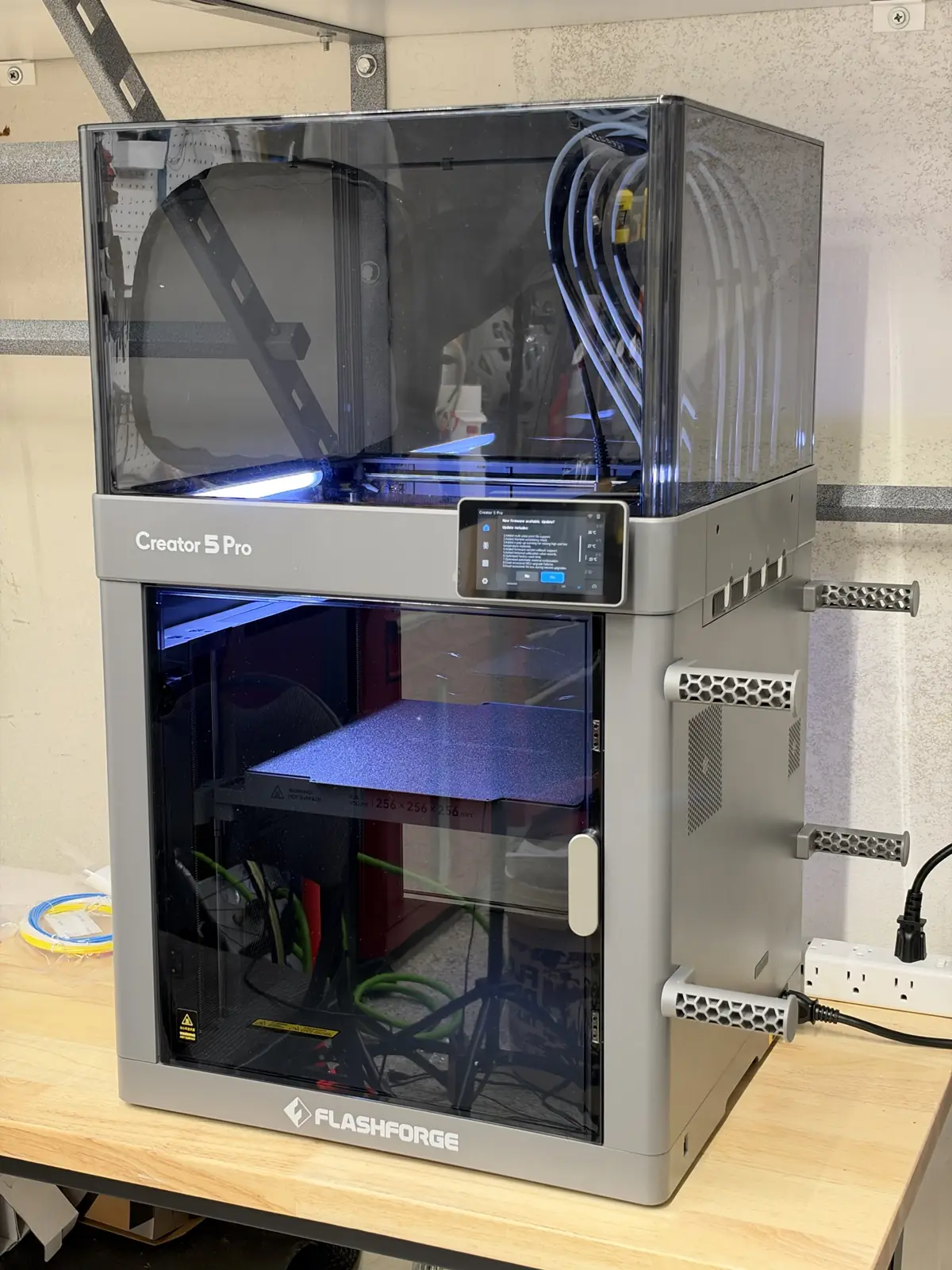
It’s on the bench now, and the first job is the firmware update it asked for the minute it powered on. After that I’ll be testing purge waste after tuning, chamber temperature compared with the 65 °C rating, tool-change accuracy between heads, and how it handles PA6-CF and ASA for real functional parts. I’ll post the results here and on the MizuMakes YouTube channel.
If you’re shopping for one, here’s the Flashforge Creator 5 Pro. Check Flashforge’s own store too, because it has had the better Black Friday price.