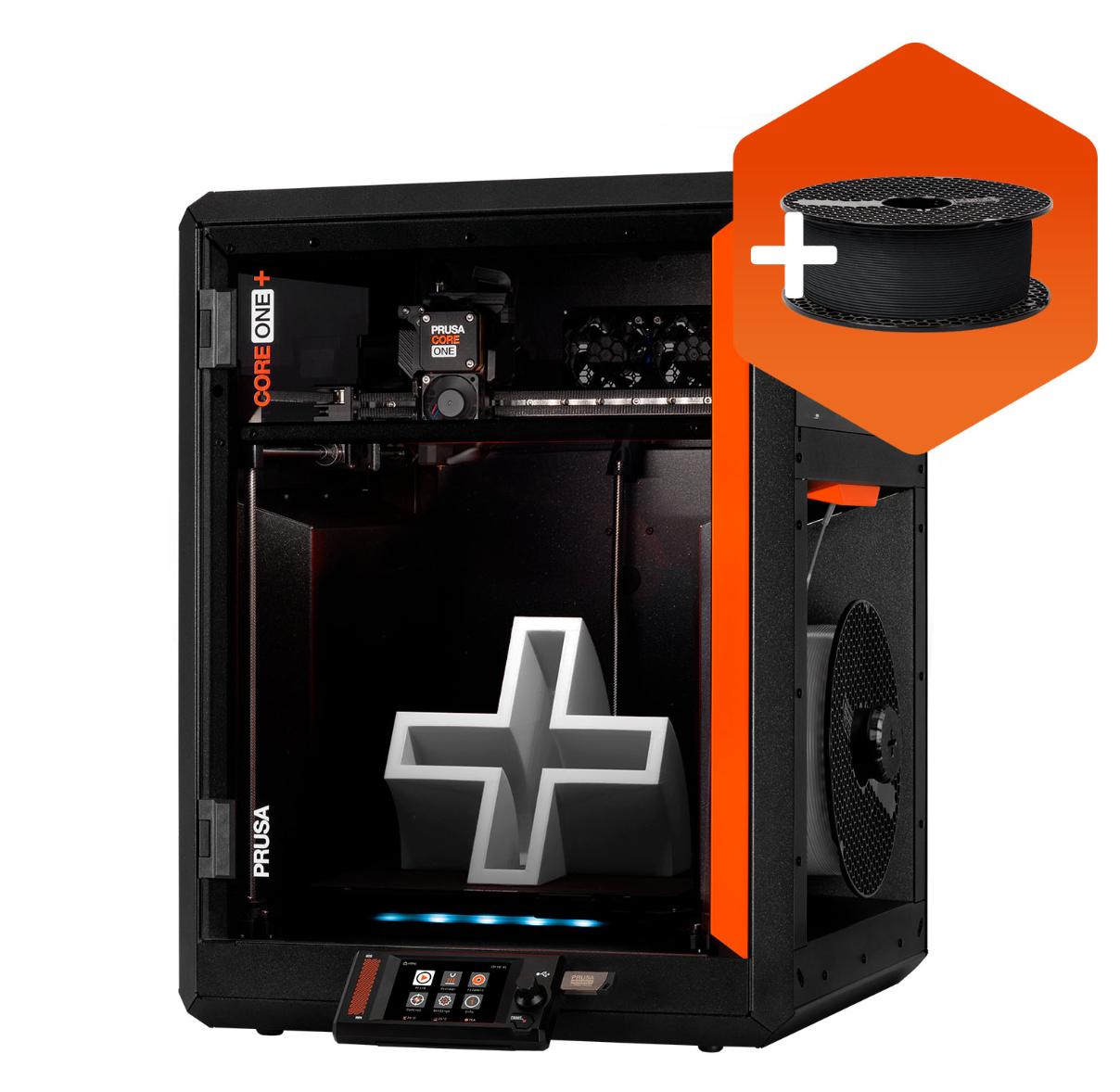
If you’ve been circling the Prusa CORE One+, the feature everyone asks about first is the heated chamber — and it’s the right thing to ask about, because it’s the single biggest reason to pick this machine over an open-frame printer. But it’s not the only thing worth knowing. Here’s a plain-English tour of what the CORE One+ actually is, what the chamber buys you, and the smaller features that add up to a nicer machine to live with.
First, a naming knot to untangle, because it trips up almost everyone: “CORE One+” and “CORE One Plus” are the same machine — the current standard model, not a pricier tier. It replaced the original 2024 CORE One rather than sitting above it, and existing CORE One owners can upgrade to “+” spec cheaply (print the parts from Printables, or buy the small official kit). More on that below. And as of a mid-August 2026 lineup refresh, there’s now a CORE One+ (Gen 2) with further tweaks — cleaner print starts, better surface finish, easier operation — so if you’re buying new, confirm which revision you’re looking at.
The heated chamber, and why it’s the headline
The CORE One+ is a fully enclosed CoreXY with active chamber temperature control up to 55 °C. That number sounds modest, but it’s the difference between “PLA and PETG only” and a genuinely material-flexible printer.
An open printer struggles with ABS, ASA, PC, and nylon because those filaments warp and split as they cool unevenly — corners lift off the plate, layers crack. A warm, enclosed chamber keeps the whole part in a stable thermal environment while it prints, which is what makes those engineering-grade materials reliable instead of a gamble. In practice, 55 °C comfortably covers ABS and ASA, and opens the door to PC and nylon. (For the lower-temperature end and where each everyday material earns its place, see my PLA vs PETG breakdown.)
The “+” made the chamber smarter, too. It has an automatic top vent: the extruder opens the vent for low-temp materials like PLA and PETG — which actually want cooler air to keep detail crisp — and closes it for high-temp runs where you want the heat trapped. On the original CORE One you flipped that grille by hand and hoped you remembered. Now it’s genuinely set-and-forget when you switch between, say, a PLA figurine and an ABS bracket in the same week.
What the “+” added over the original CORE One
Beyond the auto vent, the “+” revision is a bundle of quality-of-life upgrades:
- Better filament loading, especially for flexibles. An improved feed path and an advanced side filament sensor with a hardware switch make TPU load and run without snagging — historically the fussiest thing to feed on any printer.
- A redesigned bayonet spoolholder. It locks firmly so the spool doesn’t walk sideways during fast retractions, and it’s modular — swap in a wider version for 2 kg Prusament spools, or mount a drybox for moisture-sensitive filament.
- All firmware improvements rolled in, and a free/cheap upgrade path so existing owners aren’t left behind. That “your machine keeps getting better” philosophy is core to how Prusa operates.
The other features that matter
The chamber gets the headlines, but a few things underneath do the quiet work:
- CoreXY speed. Prusa officially rates the CORE One as roughly 20% faster than the bed-slinger MK4S at equivalent quality, a margin outside reviewers have independently verified. It’s quick without needing you to trade away surface quality.
- All-steel exoskeleton. The steel case is the frame, which keeps the machine rigid at speed and, per Prusa, very hard to damage. Nothing’s welded or glued — it comes apart with a screwdriver, which matters when something eventually needs service.
- Nextruder with a high-flow CHT nozzle as standard, plus load-cell first-layer calibration that sets the gap automatically instead of asking you to eyeball it. The “+” Nextruder adds 360° part cooling for cleaner overhangs.
- Quiet. Around 48 dB in normal operation — closer to “background hum” than “shop tool.”
- The Prusa ecosystem in one box: PrusaSlicer, Prusa Connect for remote monitoring, a massive model library on Printables, open-source hardware and firmware, and long-term support. It’s an enclosed CoreXY that earned All3DP’s Best Enclosed 3D Printer honors and a Red Dot Award.
Room to grow: MMU3 and the INDX
One reason the CORE One+ is a smart long-term buy is that multi-material isn’t a dead end. You can add the MMU3 for affordable five-filament color on a single nozzle, or step up to the INDX, the eight-tool changer that gives each material its own dedicated nozzle for true functional multi-material — mixed flexibility, soluble supports, different nozzle sizes in one print. I dug into whether that’s worth it right now in why the 8-tool Prusa INDX might be my next printer (short version: exciting, but mid-rollout).
How it compares to Bambu
The obvious cross-shop is Bambu Lab, and the split comes down to philosophy. Bambu leans closed and appliance-like — a slick sealed AMS and a “just works” experience, which is exactly why I still point color-first buyers there in my P1S vs P2S guide and the 2026 Bambu lineup rundown. The CORE One+ trades a little of that turnkey polish for openness, repairability, and a multi-material path you own rather than rent. If you value being able to fix, mod, and understand your machine, that trade is the whole point.
The honest trade-offs
- It’s heavy. Around 22.5 kg. It’s not a printer you relocate casually — plan its shelf before you buy.
- The interface feels dated. It’s a scroll-wheel-and-button UI rather than a modern touchscreen. It works fine; it just doesn’t feel 2026.
- It’s a newer platform. The troubleshooting history is thinner than something that’s been in thousands of hands for years, and early kits weren’t drama-free. If you want the most well-trodden path, factor that in.
What it costs
As listed on Prusa’s CORE One+ page in mid-2026, it starts around $949 for the kit or $1,199 assembled — verify the current figure and exactly what’s in the box before you order, since the mid-August Gen 2 refresh and ongoing pricing changes can move both. (Third-party sellers often list higher.)
[OPTIONAL PERSONAL NOTE — if you want a first-person angle: a line on whether the chamber solves a specific material problem you keep hitting, kept truthful. Delete this bracket if you’d rather leave the piece as a straight overview.]
Bottom line: the CORE One+ is the enclosed CoreXY to beat if you want engineering materials, real repairability, and a platform that grows with you — and the 55 °C chamber is what makes the rest of it worth having.
Specs and pricing here reflect mid-August 2026 and change quickly — verify against the live Prusa store before buying.